Hitobashira
What is it?
Hitobashira (human pillar), practiced formerly in Japan, is a human sacrifice, buried alive under or near large-scale buildings like dams, bridges, and castles, as a prayer to the gods so that the building is not destroyed by natural disasters such as floods or by enemy attacks. Hitobashira can also refer to workers who were buried alive under inhumane conditions.
Here are a few recorded cases (based on the Wiki):
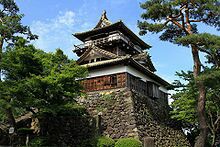
When Shibata Katsutoyo, the nephew of Shibata Katsuie, was building a castle in Maruoka, the stone wall of the castle kept collapsing no matter how many times it was piled up. There was one vassal who suggested that they should make someone a human sacrifice (itobashira). O-shizu, a one-eyed woman who had two children and lived a poor life, was selected as the Hitobashira. She resolved to become one on the condition that one of her children be made a samurai. She was buried under the central pillar of the castle keep. Soon after that the construction of the castle keep was successfully completed. But Katsutoyo was transferred to another province, and her son was not made a samurai. Her spirit felt resentful, and made the moat overflow with spring rain when the season of cutting algae came in April every year. People called it, "the rain caused by the tears of O-shizu's sorrow" and erected a small tomb to soothe her spirit. There was a poem handed down,"The rain which falls when the season of cutting algae comes Is the rain reminiscent of the tears of the poor O-shizu's sorrow".
><><><><><><><
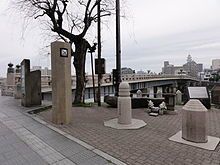
When Horio Yoshiharu, the great general who became daimyo of Izumo in the Keichō era, first undertook to put a bridge over the mouth of this river, the builders laboured in vain; for there appeared to be no solid bottom for the pillars of the bridge to rest upon. Millions of great stones were cast into the river to no purpose, for the work constructed by day was swept away or swallowed up by night. Nevertheless, at last the bridge was built, but the pillars began to sink soon after it was finished; then a flood carried half of it away and as often as it was repaired so often it was wrecked. Then a human sacrifice was made to appease the vexed spirits of the flood. A man was buried alive in the river-bed below the place of the middle pillar, where the current is most treacherous, and thereafter the bridge remained immovable for three hundred years. This victim was called Gensuke who had lived in the street of Saikamachi. It had been determined that the first man who should cross the bridge wearing a hakama without a machi (a stiff piece of material to keep the folds of the garment perpendicular and neat-looking) should be put under the bridge. Gensuke passed over the bridge without a machi in his hakama and was sacrificed. The middle-most pillar of the bridge was for three hundred years called by his name "Gensuke-bashira". Some believe the name Gensuke was not the name of a man but the name of an era, corrupted by local dialect. The legend is so profoundly believed, that when the new bridge was being built (c.1891) thousands of country folk were afraid to come to town; for rumours arose that a new victim was needed, who was to be chosen from among them?
><><><><><><><
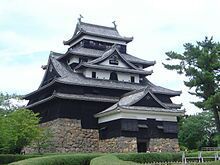
According to legend the Matsue Castle is also said to have been constructed on a human sacrifice that was buried under the castle's stone walls. Her name has never been recorded, nothing concerning her is remembered except that she is thought to have been a beautiful young maiden who was fond of dancing and is referred to as simply the maiden of Matsue. After the castle was built, a law was passed forbidding any girl to dance in the streets of Matsue because the hill Oshiroyama would shudder and the castle would shake from "top to bottom".
~~~~~~~~~~
Luckily, the Japanese don't practice this anymore... Right?!
Bạn đang đọc truyện trên: AzTruyen.Top